ACTESTNETAlternating Current
Simulation of the ACPROTOCOL flow: pick a sample document and follow the full cycle, from reading to canonical answer.
Illustrative demonstration with synthetic data · Alternating Current of Canonical Identity
Sample document
REAL ESTATE · Municipalities and registries
📄Property registry recordPDF · first entry
📷The same record photographedJPEG · same content
📄Record with a new annotationPDF · the asset evolved
📷Illegible photo of a recordJPEG · insufficient reading
RECEIVABLES · Banks and capital markets
🧾Book-entry trade receivableXML · registry
🧾The same receivable in another securitizationXML · presented again
🧾Receivable with an amendmentXML · due date changed
🧾Receivable with incomplete dataXML · incomplete key
Canonical answer
Pick a document and run the demo.
ACCANONIC · TESTNET mode
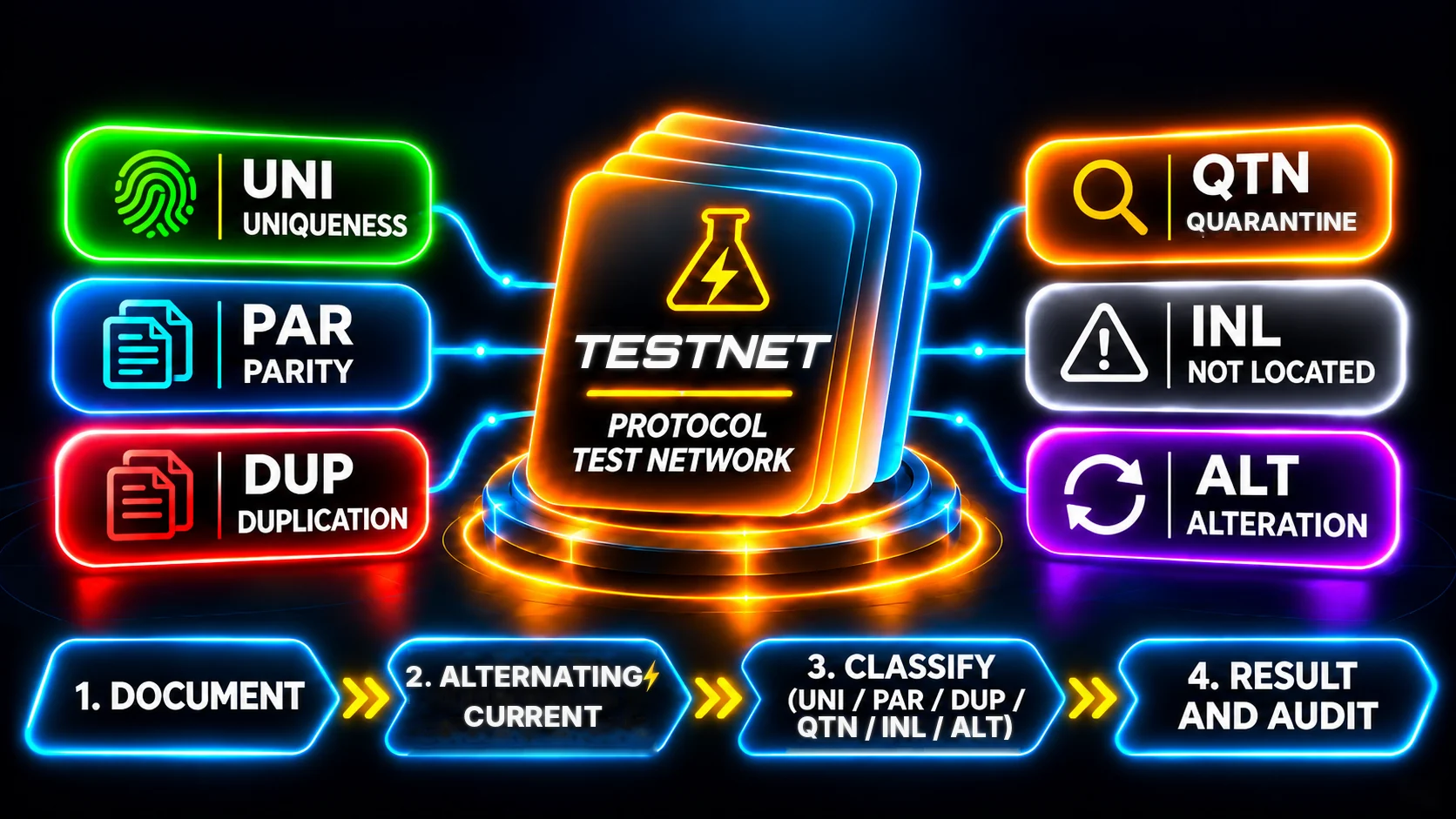
5 AlternatingCurrent Classification States
Every occurrence processed by the Canonical Engine is classified into one of six fundamental states — UNI, PAR, DUP, QTN, INL or ALT — which structure the AlternatingCurrent decision logic and will serve as the basis for the broader queries and answers of ACORACLE. The examples above simulate a registration operation.
ACUNI
First occurrence registered in AlternatingCurrent.
Alternating Current Uniqueness
ACPAR
Same identity, document evolution.
Alternating Current Parity
ACDUP
Duplicated asset.
Alternating Current Duplication
ACQTN
Quarantine: an occurrence whose identity or state has not yet been securely validated, isolated for further analysis.
Alternating Current Quarantine
ACINL
Not Located: identity not located or reading insufficient to recognize the asset with certainty.
Alternating Current Not Located
ACALT
Alteration identified.
Alternating Current Alteration
UNI and QTN look similar, but they are opposites.
UNI — AlternatingCurrent recognizes the asset and records its first pass through the AlternatingCurrent, generating its canonical identity.
QTN — asset under evaluation.