A persistent mathematical identity for a real-world asset whose state can change
without losing its identity, provenance or evolutionary history.
CANONICAL IDENTITY ORACLE · PATENT PENDING
ACPROTOCOL
AC⚡IDN — CANONICAL IDENTITY NUMBER
The AC⚡IDN mathematical identifier recognizes the same asset across any file extension,
spelling, format or system of origin — and preserves its full evolution over time.
PATENT PENDING — BRAZIL INPI BR 10 2026 010732-8DETERMINISTIC ENGINE — NO AI, NO PROBABILITYBLOCKCHAIN-AGNOSTIC
AC⚡PROTOCOL•Alternating⚡Current of Canonical Identity•AC⚡PROTOCOL•Corrente⚡Alternada de Identidade Canônica•AC⚡PROTOCOL•Alternating⚡Current of Canonical Identity•AC⚡PROTOCOL•Corrente⚡Alternada de Identidade Canônica•
Demonstration
See the Alternating⚡Current in action
From physical document to blockchain-anchored canonical identity — the full cycle in seconds.
AC⚡PROTOCOL — Alternating⚡Current Of Canonical IdentityNSTRATION
Verifiable Identity
AC⚡ Official QR
When the vertical requires field tracking, the canonical identity is published as a QR
— free reading for citizens, millisecond verification for institutions.
SCAN → ACPROTOCOL.ORG
The Protocol
Generates. Verifies. Preserves.
Three architectural families, one single backbone: the Canonical Life Cycle of the asset —
from the birth of its identity to its authorized evolution.
ACCore Engine
Generates identity. Produces a deterministic identifier from the asset's permanent elements
— the same asset always produces the same AC⚡IDN, in any spelling, format or system.
ACOracle
Verifies identity. Deterministic canonical decision with permanent memory (AC⚡Master Keys)
and five public responses: AC⚡UNI [Unique] · AC⚡DUP [Duplicity] · AC⚡PAR [Parity] · AC⚡QTN [Quarantine] · AC⚡INL [Identity not located or document illegible].
ACCanonical Timeline
Preserves evolution. Detects duplication and builds the asset's tree and its updated
timeline — versions, variants and the chain of authorizations behind every change,
without ever losing canonical identity.
HASH BREAKS — ALTERNATING CURRENT
FROM PAPER TO IMMUTABLE IN SECONDS
"A common hash tells you if two files are identical.
AC⚡PROTOCOL Alternating⚡Current tells you if two assets are the same one — and what happened to it since."
Behind these three families, two distinct layers: the Universal Engine (AC⚡MAP + AC⚡SCAN) interprets and prepares any input; the Canonical Engine never interprets — it verifies, from Canonical Keys and deterministic rules. See the full architecture →
Reference Architecture
Seven layers, one identity
From the engine's mathematics to the global ecosystem — each layer with a single responsibility.
LAYER 1
Core Engine
[Deterministic engine responsible for generating the Canonical Identity.]
LAYER 2
Security
[Protection against fraud, tampering and inconsistencies.]
LAYER 3
Identity
[Generation and management of canonical identities.]
LAYER 4
Tokenization
[Transformation of assets into digital representations.]
LAYER 5
RWA
[Integration of real-world assets.]
LAYER 6
Compliance
[Governance, legal conformity, audit and regulatory validity.]
LAYER 7
Ecosystem
[Applications, services and infrastructure built on the protocol.]
Vision — Roadmap
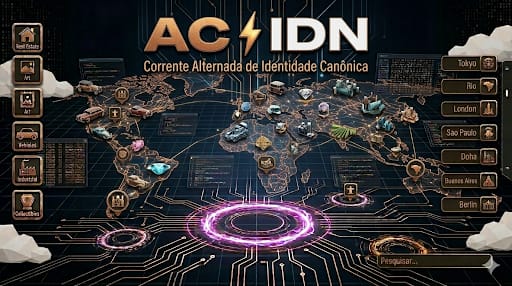
AC⚡GLOBE — the federated marketplace for real-world assets
On top of canonical identity rises the application layer: tokenization,
trading and federation of RWAs by jurisdiction — Country → State → Municipality → Category.
In planning; architecture documented in the AC⚡Papers.
The document may have been born yesterday, today — or not yet exist
The canonical identity is the same. What changes is where the proof comes from.
PAST
The archive that already exists
Paper or scanned documents created before any canonical identity. Assisted reading of
the content, with a declared evidence level and verification where required. Once
admitted, the asset enters the timeline like any other.
PRESENT
Data that arrives already proven
Registries, central bank, notary offices, digital signatures. The proof does not come
from reading the paper — it comes from the source. Deterministic identity, with no
reading and no interpretation.
FUTURE
Identity at the source
The asset is born with a canonical identity at the very moment of its creation, through
native integration into document creation and registration systems. No reading, no
extraction, no later reconstruction.
ROADMAP
The origin of the data changes. The identifier does not.
The engine's internal architecture is protected by a pending patent
and disclosed under a non-disclosure agreement.
Full Transparency
What's proven — and what's roadmap
PROVEN TODAY
Patent filed with Brazil's INPI (05/2026) + technical evolution kit
Proprietary engine implemented and tested in a controlled environment
Five public responses from the AC⚡Parity Engine
Official documentation: AC⚡Papers + Official Vocabulary
ROADMAP
Public demo and tiered commercial API
AC⚡SECURITY: canonical authentication and consent
AC⚡ZKS: zero-knowledge proof
International PCT phase and new protection filings
International corporate structure (US)
AC⚡GLOBE — federated RWA marketplace
Partners
Build on canonical identity
Banks, land registries, exchanges and RWA platforms:
the founding partners program opens together with the public API.
Get in touch for early access to the technical documentation.